Wednesday, January 27, 2016

PLAY THE BALL, NOT THE PERSON

Fundamentalism, in a nutshell, is over-simplifying the world into two camps: mine and everyone else’s. It is a philosophy born out of stereotyping a particular race, culture or faith - generalising the most extreme from within that camp and extrapolating to everyone who identifies with it. It is a mindset that cannot see nuance and difference between individuals. Everything is black or white; there is no grey.

Unfortunately, life is grey. No two people think alike. There may be Arab terrorists, but that doesn’t make all Arabs terrorists. It doesn’t even make most Arabs terrorists.

This Letter to the Rabbi appeared in a UK Jewish Newspaper last week:

Female rabbis acceptable?
Dear Rabbi,
I was always sceptical about ordained Orthodox female rabbis. And now one has been given a job in an Orthodox synagogue. That should surely suggest it is becoming acceptable. Do you envisage that happening in the UK?
Gregory

Dear Gregory
In a word, no. Don’t get me started on these pseudo-suffragettes, or should that read “rabbragettes”? In any event, she got a job in an “Open-Orthodox” synagogue – whatever that means. Suffice it to say, a little digging and one discovers on the website that on the High Holidays they have a “family section” in their synagogue, i.e, no mechitza and men and women sit together.
So, in summation, when someone gets “ordained” in some so-called Orthodox manner and immediately takes up her posting in a synagogue that breaches some of the fundamentals of Orthodoxy (I guess that’s what they mean by “open”), then you have to call into question the establishment that “ordains” these women and indeed the women’s own levels of conviction.
My father always told me: “If the end result is no good, then you know the whole premise is flawed.”

Personally I am not in favour of the ordination of women, but to state that every woman who is interested in ordination is agenda-driven and fundamentally flawed is both overly simplistic and panders to the extreme elements in our community.

I cannot know the personal motivation of each feminist. Some may have agendas, but I am sure that many are as sincere in their belief as I claim to be.

How can this Rabbi claim to “know the inner rumblings of the heart”?  Is he so all-knowing that he can dismiss others with whom he disagrees, not on halachic or philosophical grounds, but rather on projected and assumed intent?

Apparently agendas are only in the other camps, not our own. 

Dear Rabbi- fight fire with fire. If you disagree, disagree on issues. Play the ball, not the person.


Monday, November 16, 2015

It's already happened

There used to be a member of the community who always responded to my greeting of "What's happening Abe?" with a casual "Rabbi I think it's already happened."
Tongue in cheek, but incredibly profound.
I have a friend who once asked for some guidance regarding whether he should propose to his girlfriend of 2 years.
"What's your doubt?"
"I don't know, but I'm not sure..."
My response was simple "Either propose or end it. If she hasn't convinced you yet then she's never going to".
In life we are so often waiting to be inspired, waiting for a sign, waiting for the right time and for the best opportunity.
The best opportunity has probably already happened.


Wednesday, October 14, 2015

You can't have your cake and eat it

Compromise is a phenomenon that none of us can escape. Whenever we invest time in any endeavour, we unavoidably deny investment in another.  We can be good at many things but we cannot be our best at anything, unless we are prepared to sacrifice other values and ideals on the altar of that success.

In 2012, Anne-Marie  Slaughter published the article "Why Women Still Can't Have it All". It was a explanation as to why she, who served as Director of Policy Planning for the United States Department of State, voluntarily left her role to spend more time with her teenage sons.

True balance in life is an illusion; we cannot have the best of all worlds. Practical balance is the acceptance of the fact that one cannot be one’s best at all areas in life; it’s the choice of which areas to excel and in which areas to capitulate.

Time is a commodity that must be budgeted. Investment in one area, detracts it from another. Priorities ultimately will determine where the commodity should be spent.


Absolute success comes with an absolute cost. 

Wednesday, October 7, 2015

The problem with immoral religious people...

Nothing outrages us ‒ both those of faith and those without ‒ more than the religiously pious who act in a socially immoral manner.
Be they thieves, philanderers or sexual deviants, the hypocrisy strikes a chord within us that stokes the coals of hatred.
We admire those who live by their principles. We respect their personal sacrifices of lifestyle, convenience and social norms to remain true to their values. We may disagree with their beliefs, but we admire their conviction.
This admiration is a moral contract. The principled person sacrifices things that many of us cannot or will not, and in turn we respect them for it. But when they fail to uphold even the most basic of moral tenets, that contract is broken. 
Our admiration was misplaced.
When that trust is broken, our moral outrage is born from feelings of deceit.


Monday, September 7, 2015

In an age of internet-assembled philosophies...

"Those who hear the warnings of this curse should not congratulate themselves, thinking, 'I am safe, even though I am following the desires of my own stubborn heart.'” (Devarim 29:18)

The verse speaks of individuals who, despite hearing the warnings of the Torah to those living an immoral life, are convinced that they are the exception to the rule; the smokers who feel they can beat the statistics.

The human personality’s natural ego considers itself immune to popular critique; we find unique ways of justifying our hypocrisy and validating our inconsistencies.

In an age of internet-assembled philosophies, we tend to think of ourselves as sophisticated and well-read, whereas in reality we have only replaced genuine self-assessment with over-inflated self-congratulations.


In the lead-up to Rosh Hashanah, a time when we try to contextualise our lives, perhaps it is opportune to develop humility. Not the humility of the self-effacing type, but rather the humility that seeks to understand before developing an opinion.

Sunday, August 30, 2015

Tolerance


Last week I participated in an interfaith dialogue between members of the Jewish, Christian and Islam faiths.
The event was both insightful and fascinating; being amongst people from such a culturally diverse spectrum seeking to find common ground during a time where religion is so often used as an excuse for separation.
In our groups we were asked to suggest ideas for promoting dialogue and fostering tolerance. Each group shared their views, a conglomeration of the group’s tri-affiliated co-religionists.
One of the groups claimed that as a prerequisite for promoting tolerance was the removal of the ‘Abbot’ government.
How ironic that the promotion of tolerance necessitates an intolerance towards those positions unaligned with my own.
I think there’s a term for that...intolerant.


Sunday, August 23, 2015

Correlation is not causation!

Anyone who has taken an intro to psych or a statistics class has heard the old adage, "correlation does not imply causation." Just because two trends seem to fluctuate in tandem, this rule posits, that doesn’t prove that they are meaningfully related to one another.
Correlation is a statistical measure that describes the size and direction of a relationship between two or more variables. 

Causation indicates that one event is the result of the occurrence of the other event; i.e. there is a causal relationship between the two events. 

Causality is the area of statistics that is commonly misunderstood and misused by people in the mistaken belief that because the data shows a correlation that there is necessarily an underlying causal relationship.

A good example is that the rate of drowning on Sydney’s beaches is positively correlated to the sale of ice cream.
An incorrect conclusion is that “the consumption of ice cream leads to drowning”. More likely the reason would be that both drowning and ice cream sales are positively affected by hot weather; more people are at the beach and more ice creams are sold- correlation does not imply causation!.
A few examples from recent articles and headlines:

“Spiritual people are more likely to be mentally ill” -The Daily Mail 
 “...children whose parents smoked were more likely to exhibit delinquent behaviour”- The Guardian
“People who have large weddings are less likely to get divorced”- Psychology Today
“Men and women who eat more of the sweets are also likely to be depressed”-LA times

“Coffee may prevent depression, scientists say”-BBC

Don’t be duped by Facebook trends- correlation does not imply causation


Sunday, August 9, 2015

Addicts and Codependents

The world of addictions is a scary one to witness. The addict is a con-artist extraordinaire. He has to be as his survival depends on it. It isn't that he wants to lie, it's that he cannot not lie. The truth is too scary and too painful. Admitting his addiction is half the problem.

But every story of addiction has another story of co-dependency- " a helping relationship where one person supports or enables another person's addiction, poor mental health, immaturity, irresponsibility, or under-achievement."

The codependent prolongs the addictive cycle; he makes excuses for the addict, bails out the addict and defends the addict. The codependent ensures that the addict need never take responsibility for his actions.
They show kindness when harshness is needed, they open their arms when their arms needed to be folded. 
Their reluctance to be perceived as the 'bad guy' dupes them into becoming the bad guy.
Addicts are not the only ones who need to be in therapy...they are just the obvious ones.

Wednesday, July 22, 2015

Can legends be true?


"In the Chinese language, the word "crisis" is composed of two characters, one representing danger and the other, opportunity."  -John F. Kennedy, Speech at United Negro College Fund fundraiser,April 1959.

In researching this quote I discovered that it is a mistranslation of the Chinese character for opportunity.
But does it really matter? Is the concept of crisis presenting an opportunity wrong?
If I can learn a true idea from a faulty proof or feel inspired by a fictional story- does it make the experience any less authentic?

Is the truth less valuable if the proof is faulty, flawed or fiction? Maybe the truth is in our conclusion?

Tuesday, July 14, 2015

When you trust someone...

How were referees introduced into sport?
Surely the earliest form of games developed out of a sense of healthy competitiveness. Two or more individuals or teams, pitted against one another in a battle of strength, skill or wit.
Games were based on trust and therefore the adjudication and fairness of a particular play or move were left in the hands of the players themselves.
With the development of the games came a corresponding raising of the stakes for winning or losing, whether financial or just for prestige. Suddenly there was an incentive to cheat.
Quickly, our honesty was questioned and we doubted the testimony of our opponent. We stood to lose too much, and our adversary gain too much. We could no longer trust or be trusted.
To reinstate fairness into the system, we introduced a neutral third party. These arbitrators would act as objective outsiders, incorruptible and fair. This ushered in the age of the referee ‒ policemen for sport.
Trust is at the core of every relationship. If you have it, the relationship will flourish; if not, it will perish.
In religious circles, trust was supported by using God as the referee.  One would take an oath or pledge using the name of God;  the fear of taking His name in vain would serve as an insurance policy, protecting against fraud and deceit.
It seems, however, that God's status as a referee has become inadequate even in religious circles. An oath in the name of God has lost its value.
If players no longer respect the referee, then the game loses all its integrity. If civil society can no longer trust one another, then society will cease to be civil.
The risk of trusting is being deceived.
The risk of not trusting is far greater.


Wednesday, July 1, 2015

Cases of mistaken identity...

First there’s a man who says he’s a woman
Then a black woman who is really a white woman
And now a white woman who thinks she a sick woman
The first case won support, the second ambivalence and the third scorn.
All cases of identities misunderstood, misconstrued or ill-conceived.

It seems that the once obvious question of identity is no longer obvious.... 

Wednesday, June 24, 2015

What is your blind spot?

Last week I discussed the inability of many to speak up about something incongruous and stupid due to social pressures, real or imagined.
The other extreme of this is having a blind spot.
People are generally motivated to view themselves in a positive light and biases are viewed as undesirable. We tend to think of our own perceptions and judgments as being rational, accurate, and free of bias when analysing our own decisions and positions.
However, when we are made aware of various biases acting on our perceptions, decisions or judgements, research has shown that we are still unable to control them. This contributes to the bias blind spot, as even if someone is told that they are biased, they are unable to alter their biased perception.
Our blind spots are the points in life where we cannot possibly perceive of any other legitimate way of viewing a particular idea or approach. The left can’t understand the right, and the right can’t see the value in the left.
Our blind spots cause us to negate contrary opinions and nullify the people who hold them. We become incapable of seeing any legitimacy in opinions and lifestyles different to our own.
Everyone is guilty of this, from the most fundamentalist ‘religo’ to the most fundamentalist atheist.
Although the blind spot is not ‘curable’, it can be treated. But like alcoholism, it requires the person to first acknowledge that they have a problem before it can be addressed.


Wednesday, June 17, 2015

Witch Hunts

Throughout history, witchcraft caused panic and fear among many communities. This resulted in the burning at the stake of anyone thought to be a ‘witch’ or believed to have dabbled in black magic. Unfortunately, it also targeted those only suspected of participating in this practice. 
In modern times, the  'witch hunt’ has become the act of seeking and persecuting any perceived enemy, particularly when the search is conducted using extreme measures and with little regard to actual guilt or innocence. At times it is sanctioned by government and at other times only by the ‘court of public opinion’.
Sadly, the casualties of these hunts are often innocent of the crimes they are accused of. During the McCarthy era, for example, many victims were perceived communists.
Often an innocent yet poorly judged comment or joke can lead to a person being labelled anti-Semitic. The abuse they subsequently suffer can, ironically, germinate negative sentiments within them, feelings never before thought of or considered.
Unfortunately, we see witch hunts happening everywhere, often targeting the innocent. The friendly overtures of a  teacher makes him a paedophile; an ill-timed joke brands the joker a racist; a poorly judged Facebook post labels the user a sex addict.
Are these innocents merely a casualty of war? Is it now accepted that the weeding out of society’s ‘scum’ necessitates collateral damage? Can’t we as a society read each story and controversy independently of popular trends and judge each person on their merit, rather than within a broader context?
My sense is we cannot.
We want blood, because even if there are unnecessary victims, at least we can sleep at night knowing that all the ‘bad men’ are behind bars, guilty or not.


Wednesday, June 10, 2015

An uneducated (or perhaps rational) view of MONA

Last week I visited the fame MONA art gallery in Hobart. By all accounts this is a "must see" when in Tasmania, or to quote the concierge at the hotel "You'll love it or hate it, but you have to see it."
I accept that I may not be the most cultured of individuals, but I would like to think of myself as being open and aware of my own ignorance. 
So when I see a famed artwork that looks like my infant nephew could have done it, I can accept that I am the one at fault and not the artist or their critics/fans.
But I too have my limits.
One of the centrepieces of the gallery is the Cloaca, a machine designed by Wim Delvoye (and a lot of scientists). It is a machine that is smelt well before it is seen. 
The purpose of the machine is literally to make human faeces. The machine is fed regular food daily through an insinkerator and then it methodically passes the digested food through multiple 'stomachs' and 'intestines', all mimicking the body. Finally the finished product is 'defecated' by the machine at 2pm every day. (According to a documentary I saw, you can purchase these 'prized' products for a mere $1500).
According to the artist, the Cloaca satirises modern art saying that most of it is ****, "this is a work of art about waste".
The only thing that remained with me after the exhibit, beside the unpleasantness of the smell that still lingers, is the irony that those who marvelled at the exhibit were the exact people the artist was mocking...
Who is missing the point, me or those who claim to understand...?

Thursday, June 4, 2015

Education at its worst...

From the beginning of time until fairly recently, education was a family affair. The family unit in general and the parents in particular prodded, nudged and guided their young by teaching them skills, etiquette and acceptable behaviour.
As civilisation progressed and the demand for skills broadened beyond the ability of individual families, education needed to be outsourced and eventually evolved into what we call schools.
For better or worse, schools are the surrogate households of today and teachers, our children’s surrogate parents. If we are to judge an educational institution based on its success, what are the KPIs (key performance indicators)?
In my opinion, the education system in the west has evolved into a “12 years preparation for HSC”. Every year is just one more stepping stone towards that all-important ATAR, which, in turn, is only valuable in order to get into the best universities.
However, if a school produces many distinguished students with enviable grades, but who lack motivation for life, what is it worth? If the character of our children is not moulded and their morals not refined, of what value is their education?
Success in life, however one defines it, cannot be relegated to a number out of 100. Do teachers view their role as merely transferring information from their heads into the heads of their students ‒ a virtual USB data transfer?
Education needs to be reframed. It isn’t about teaching people what to think, but rather how to think. Education is giving children the life skills needed to know how to approach difficult problems, how to confront moral dilemmas and how to create meaningful lives.
No ATAR can ever do that.


Wednesday, May 27, 2015

If you could have a superpower what would it be? Why?

 
Do we possess a natural inclination to morally refine ourselves? Is there a drive to change ourselves, our environment and ultimately the world?
From an evolutionary view point, prominent atheists such as Sam Harris have suggested the logical and mutually beneficial rationale for the ‘inherent’ desire within man to be good. “We are good because it works in our favour in the long run. Society will be safer because we need to trust one another,” claims Harris.
Theists would point to our God-given souls that pine to cleave to God and His goodness as the inner spark for moral redemption.
Both approaches seem to suggest that, at least in principle, we want to not only be good, but be better.
Is this true?
Given an opportunity to do an anonymous good deed, would we? Do we look for opportunities to help, or pretend we are blind to the injustices and misfortunes of others?
Would a cash windfall motivate us to direct that windfall towards making a positive impact on our surroundings, or would we self-servingly use it as a means to take more for ourselves?
In a witty, insightful and somewhat confronting and depressing piece, author and actor John Hodgman conducted an informal survey in which he asked people to choose a super power they would ask for if they could. It became evident that how we answer the question reflects a lot about the kind of person we are.
“Does the choice of power indicate the person you wish you could be, or reveal the person you’re afraid you already are?”
Sadly, “No matter which power people choose, they never use it to fight crime.”
If we are indeed designed, by nature or by divinity, to strive for goodness, perhaps many of us are lemons...


Wednesday, May 20, 2015

Have we become irrelevant to the next generation? or We have become to the next generation!

Historically, the passing of the baton from generation to generation was considered a transfer of the mantle of wisdom and leadership. Our antecedents were appreciated and respected for their knowledge and worldly experience; they were our guiding lights.
The broad-based value of honouring elders in general, and parents in particular, was always understood as a statement of deference and admiration. It was a way for society to acknowledge the social hierarchy, with seniors considered superior, both in character and wisdom, than their progeny.
But we live in a different era. The knowledge of our elders has become redundant. Their frames of reference are insignificant and their wisdom is obsolete. Children are worldlier than their parents even before they reach adolescence, and the accepted paradigm of parental wisdom is all but nullified. People have become fossilised while still in the prime of their lives.
Perhaps there are two dialectical responses. On the one hand we can accept the new paradigm and all that it entails; we cannot change progress. Our relationships with our children will be more cordial than reverential, and more casual than respectful. As parents our roles as models will be ever decreasing.
An alternate approach is to become moral giants by committing ourselves to lives of value and purpose. By investing in our character, we act as a guiding light to our children. We may know less than them, but we will always be 20 or 30 years ahead of them in terms of character refinement. We will always have something to teach, and they something to learn.

But it requires willpower to be that example, to be endearing and enduring role models.

Wednesday, May 13, 2015

Us and Them...

Xenophobia: "Deep-rooted, irrational hatred towards foreigners" (Oxford English Dictionary)
The interaction with ‘others’ presents a challenge to all people of all faiths, races and cultures. We are challenged to look beyond superficial differences and to find the inner being, the human part that we all share.
I am not sure whether we in society are becoming more tolerant of each other, or more splintered. I regularly overhear conversations dealing with ‘us’ and ‘them’, where ‘We’ are the preferred lifestyle and value choice, and ‘They’ are to be distanced, excluded and, at times, ostracised.
Racism is born out of a narcissistic sense of superiority. Whether the group is privileged by virtue of birth (colour and culture) or by way of choice (religion), this innate conviction of superiority results from a deep insecurity and self-doubt. The louder I shout, the less convinced I am.
“And you shall love the stranger, for you were a stranger in the land of Egypt.” The Torah demands that we see ourselves in others.

Our common humanity unites us, our pithy insecurities divide us.

Wednesday, May 6, 2015

Role Models

In a beautiful column I read recently by David Brooks, he cites two kinds of value systems, or, to be more specific, two different kinds of bucket lists.

There is the professional bucket list, which details the goals and ambitions we must achieve to attain prestige, wealth and honour in our lives.

The second list is the eulogy bucket list, the one which details the things we accomplish and people we touch that will leave our lasting legacy.

Most of us invest more time in the former than the latter, although I imagine we are more sensitive to and enamoured with the latter than the former.

How can we re-direct our efforts in a way that would re-focus our goals and ambitions?

One way is through role models.

Role models are those individuals who have trail-blazed the path towards perfection. Are our role models people of character, people of ethics and people of morality? Do our role models inspire us to be better, kinder and gentler?

As parents, the role models we wish for our children should be us...are we the role models we want for them...?

Wednesday, April 29, 2015

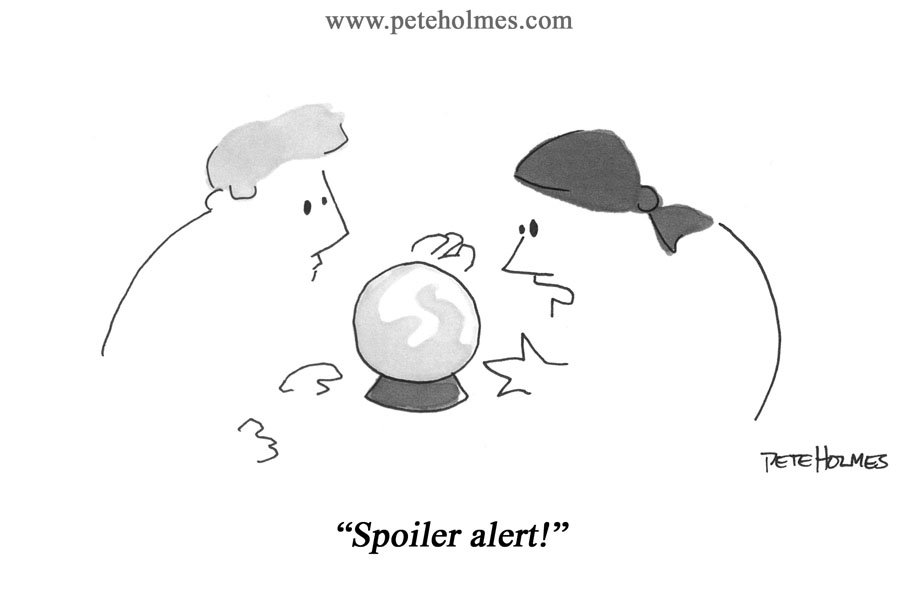
Tell me the future...PLEASE!

Last week I took a drive up the coast to a ‘Psychic Fair’. 
I went as a sceptic and left as a cynic.
Of greater interest than the psychics were the people who sought their services ‒ honest, hard-working Australians who were desperate to catch a glimpse of their futures or to receive messages of consolation from the ‘other side’. Their guiding motive was to have the hidden revealed.
Knowing the future is power; uncertainty leads to feeling vulnerable. Anxiety is the fear of uncertainty, “what might happen”.
There are two responses to anxiety:
1.     To put in every effort to create certainty.
2.     To accept life’s inherent uncertainty.
In most cases, the first option is ideal. If I can predict the future, then I can ensure I am fully prepared for it. But can you be fully prepared? What if the predictions are wrong?
A more considered response to uncertainty isn’t panic, but rather acceptance. It’s not that certainty isn’t desirable, it’s that it’s unattainable ‒ there are too many variables.
The false prophets promising guarantees of financial security, perfect health and ideal relationships do their ‘followers’ a disservice. The hard work of preparing for the challenges of life is the only guarantee. There are no short-cuts.