Wednesday, June 10, 2015

An uneducated (or perhaps rational) view of MONA

Last week I visited the fame MONA art gallery in Hobart. By all accounts this is a "must see" when in Tasmania, or to quote the concierge at the hotel "You'll love it or hate it, but you have to see it."
I accept that I may not be the most cultured of individuals, but I would like to think of myself as being open and aware of my own ignorance. 
So when I see a famed artwork that looks like my infant nephew could have done it, I can accept that I am the one at fault and not the artist or their critics/fans.
But I too have my limits.
One of the centrepieces of the gallery is the Cloaca, a machine designed by Wim Delvoye (and a lot of scientists). It is a machine that is smelt well before it is seen. 
The purpose of the machine is literally to make human faeces. The machine is fed regular food daily through an insinkerator and then it methodically passes the digested food through multiple 'stomachs' and 'intestines', all mimicking the body. Finally the finished product is 'defecated' by the machine at 2pm every day. (According to a documentary I saw, you can purchase these 'prized' products for a mere $1500).
According to the artist, the Cloaca satirises modern art saying that most of it is ****, "this is a work of art about waste".
The only thing that remained with me after the exhibit, beside the unpleasantness of the smell that still lingers, is the irony that those who marvelled at the exhibit were the exact people the artist was mocking...
Who is missing the point, me or those who claim to understand...?

Thursday, June 4, 2015

Education at its worst...

From the beginning of time until fairly recently, education was a family affair. The family unit in general and the parents in particular prodded, nudged and guided their young by teaching them skills, etiquette and acceptable behaviour.
As civilisation progressed and the demand for skills broadened beyond the ability of individual families, education needed to be outsourced and eventually evolved into what we call schools.
For better or worse, schools are the surrogate households of today and teachers, our children’s surrogate parents. If we are to judge an educational institution based on its success, what are the KPIs (key performance indicators)?
In my opinion, the education system in the west has evolved into a “12 years preparation for HSC”. Every year is just one more stepping stone towards that all-important ATAR, which, in turn, is only valuable in order to get into the best universities.
However, if a school produces many distinguished students with enviable grades, but who lack motivation for life, what is it worth? If the character of our children is not moulded and their morals not refined, of what value is their education?
Success in life, however one defines it, cannot be relegated to a number out of 100. Do teachers view their role as merely transferring information from their heads into the heads of their students ‒ a virtual USB data transfer?
Education needs to be reframed. It isn’t about teaching people what to think, but rather how to think. Education is giving children the life skills needed to know how to approach difficult problems, how to confront moral dilemmas and how to create meaningful lives.
No ATAR can ever do that.


Wednesday, May 27, 2015

If you could have a superpower what would it be? Why?

 
Do we possess a natural inclination to morally refine ourselves? Is there a drive to change ourselves, our environment and ultimately the world?
From an evolutionary view point, prominent atheists such as Sam Harris have suggested the logical and mutually beneficial rationale for the ‘inherent’ desire within man to be good. “We are good because it works in our favour in the long run. Society will be safer because we need to trust one another,” claims Harris.
Theists would point to our God-given souls that pine to cleave to God and His goodness as the inner spark for moral redemption.
Both approaches seem to suggest that, at least in principle, we want to not only be good, but be better.
Is this true?
Given an opportunity to do an anonymous good deed, would we? Do we look for opportunities to help, or pretend we are blind to the injustices and misfortunes of others?
Would a cash windfall motivate us to direct that windfall towards making a positive impact on our surroundings, or would we self-servingly use it as a means to take more for ourselves?
In a witty, insightful and somewhat confronting and depressing piece, author and actor John Hodgman conducted an informal survey in which he asked people to choose a super power they would ask for if they could. It became evident that how we answer the question reflects a lot about the kind of person we are.
“Does the choice of power indicate the person you wish you could be, or reveal the person you’re afraid you already are?”
Sadly, “No matter which power people choose, they never use it to fight crime.”
If we are indeed designed, by nature or by divinity, to strive for goodness, perhaps many of us are lemons...


Wednesday, May 20, 2015

Have we become irrelevant to the next generation? or We have become to the next generation!

Historically, the passing of the baton from generation to generation was considered a transfer of the mantle of wisdom and leadership. Our antecedents were appreciated and respected for their knowledge and worldly experience; they were our guiding lights.
The broad-based value of honouring elders in general, and parents in particular, was always understood as a statement of deference and admiration. It was a way for society to acknowledge the social hierarchy, with seniors considered superior, both in character and wisdom, than their progeny.
But we live in a different era. The knowledge of our elders has become redundant. Their frames of reference are insignificant and their wisdom is obsolete. Children are worldlier than their parents even before they reach adolescence, and the accepted paradigm of parental wisdom is all but nullified. People have become fossilised while still in the prime of their lives.
Perhaps there are two dialectical responses. On the one hand we can accept the new paradigm and all that it entails; we cannot change progress. Our relationships with our children will be more cordial than reverential, and more casual than respectful. As parents our roles as models will be ever decreasing.
An alternate approach is to become moral giants by committing ourselves to lives of value and purpose. By investing in our character, we act as a guiding light to our children. We may know less than them, but we will always be 20 or 30 years ahead of them in terms of character refinement. We will always have something to teach, and they something to learn.

But it requires willpower to be that example, to be endearing and enduring role models.

Wednesday, May 13, 2015

Us and Them...

Xenophobia: "Deep-rooted, irrational hatred towards foreigners" (Oxford English Dictionary)
The interaction with ‘others’ presents a challenge to all people of all faiths, races and cultures. We are challenged to look beyond superficial differences and to find the inner being, the human part that we all share.
I am not sure whether we in society are becoming more tolerant of each other, or more splintered. I regularly overhear conversations dealing with ‘us’ and ‘them’, where ‘We’ are the preferred lifestyle and value choice, and ‘They’ are to be distanced, excluded and, at times, ostracised.
Racism is born out of a narcissistic sense of superiority. Whether the group is privileged by virtue of birth (colour and culture) or by way of choice (religion), this innate conviction of superiority results from a deep insecurity and self-doubt. The louder I shout, the less convinced I am.
“And you shall love the stranger, for you were a stranger in the land of Egypt.” The Torah demands that we see ourselves in others.

Our common humanity unites us, our pithy insecurities divide us.

Wednesday, May 6, 2015

Role Models

In a beautiful column I read recently by David Brooks, he cites two kinds of value systems, or, to be more specific, two different kinds of bucket lists.

There is the professional bucket list, which details the goals and ambitions we must achieve to attain prestige, wealth and honour in our lives.

The second list is the eulogy bucket list, the one which details the things we accomplish and people we touch that will leave our lasting legacy.

Most of us invest more time in the former than the latter, although I imagine we are more sensitive to and enamoured with the latter than the former.

How can we re-direct our efforts in a way that would re-focus our goals and ambitions?

One way is through role models.

Role models are those individuals who have trail-blazed the path towards perfection. Are our role models people of character, people of ethics and people of morality? Do our role models inspire us to be better, kinder and gentler?

As parents, the role models we wish for our children should be us...are we the role models we want for them...?

Wednesday, April 29, 2015

Tell me the future...PLEASE!

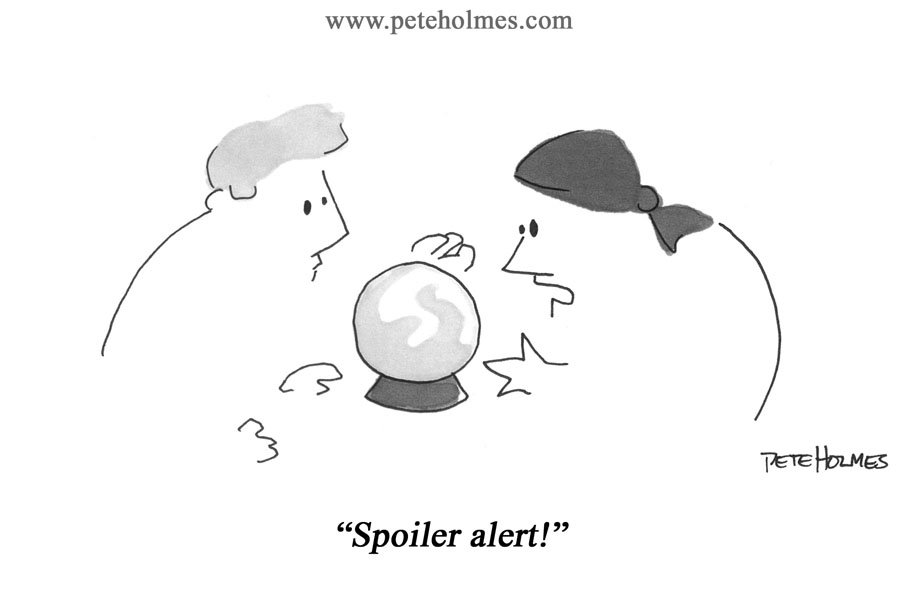
Last week I took a drive up the coast to a ‘Psychic Fair’. 
I went as a sceptic and left as a cynic.
Of greater interest than the psychics were the people who sought their services ‒ honest, hard-working Australians who were desperate to catch a glimpse of their futures or to receive messages of consolation from the ‘other side’. Their guiding motive was to have the hidden revealed.
Knowing the future is power; uncertainty leads to feeling vulnerable. Anxiety is the fear of uncertainty, “what might happen”.
There are two responses to anxiety:
1.     To put in every effort to create certainty.
2.     To accept life’s inherent uncertainty.
In most cases, the first option is ideal. If I can predict the future, then I can ensure I am fully prepared for it. But can you be fully prepared? What if the predictions are wrong?
A more considered response to uncertainty isn’t panic, but rather acceptance. It’s not that certainty isn’t desirable, it’s that it’s unattainable ‒ there are too many variables.
The false prophets promising guarantees of financial security, perfect health and ideal relationships do their ‘followers’ a disservice. The hard work of preparing for the challenges of life is the only guarantee. There are no short-cuts.